Buying Guide
Blade vs. Laser Screen Protector Cutting Machines: 2026 Buying Guide for Retailers
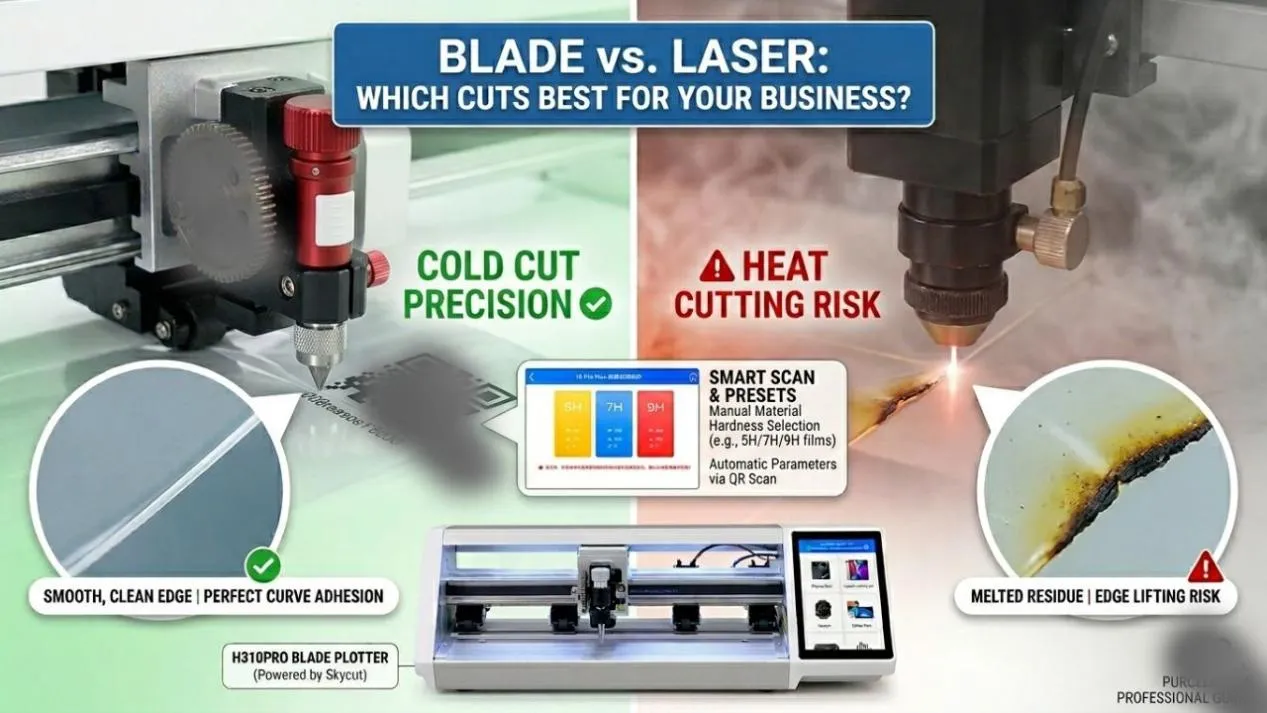
The mobile accessories industry has shifted toward on-demand cutting. Retailers face a critical decision between precision blade plotters and laser cutters — with significant implications for ROI, quality and daily operations.
| Factor | Blade Cutter | Laser Cutter |
|---|---|---|
| Film Types | TPU, hydrogel, PET, privacy | Rigid plastics, leather |
| Accuracy | ±0.05mm (mechanical) | ±0.1mm (thermal drift) |
| Operating Cost | $0.02–0.05 (blade wear only) | $200+ tube replacement |
| Fumes / Ventilation | None required | VOCs, exhaust system needed |
| Edge Quality on TPU | Clean, stable adhesion | Melted micro-beads, edge lifting |
The TPU Adhesion Problem: Laser cutting creates microscopic melted plastic beads along edges, causing edge lifting within 48 hours on TPU materials. Blade cutters provide chemically stable edges that bond perfectly to curved displays.
The Hidden "Software" Factor: Purcell's cloud database updates within 24 hours for new phone models globally, with precision tolerances unavailable in typical laser software libraries.
Maintenance: $2 vs. $200: Blade replacements cost approximately $2, last 300–500 cuts and install in 10 seconds. Laser tube replacement exceeds $200 with significant downtime.
Shopping malls frequently prohibit equipment generating smoke or odours. Laser cutters produce VOCs requiring industrial filtration systems costing $400+ in addition to equipment costs. Blade cutters have zero ventilation requirements.
Lasers suit wholesale refurbishers processing 1,000+ rigid protectors daily, customisation specialists working with leather or wood, or operations with dedicated ventilation infrastructure already in place.
Blade machines provide faster ROI with entry prices starting around $400 and negligible operating costs. Most clients recover their investment within 30–45 days. For 95% of retail screen protection scenarios, the blade cutter is the professional choice.
← Back to News